
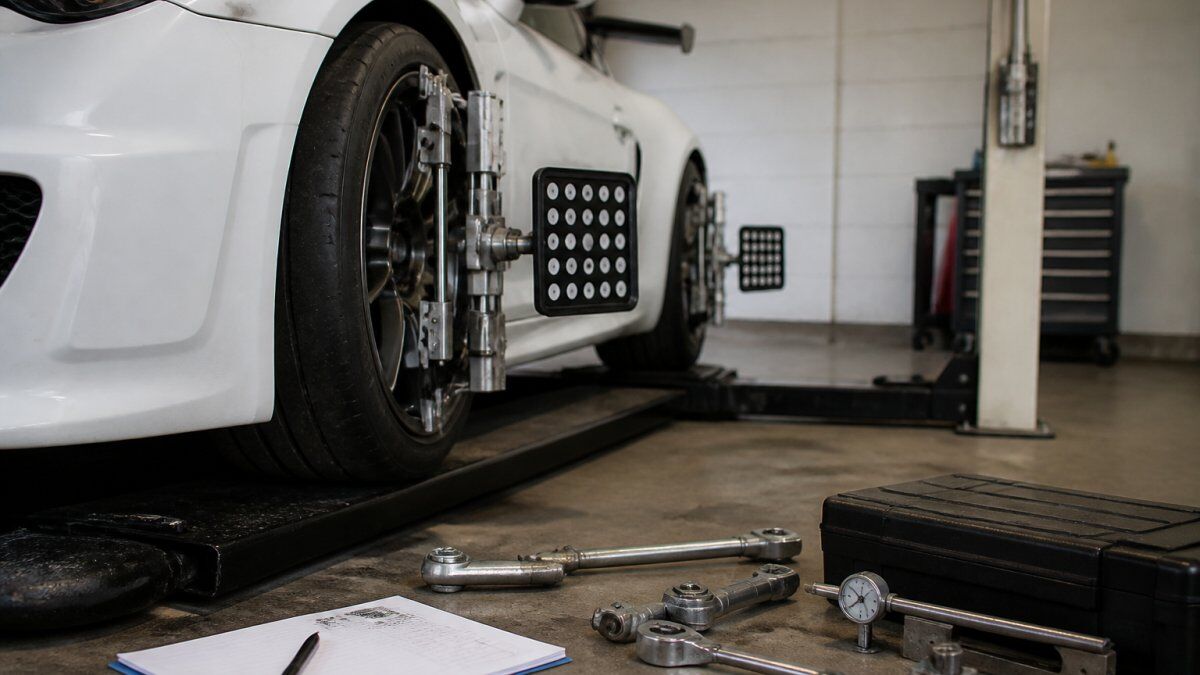
Wheel alignment for track cars: A 2026 guide
October 19, 2026Online Garage Booking for Performance Diagnostics
October 20, 2026
Table of Contents
- Why Track Car Reliability Upgrades Matter More Than Power
- Track Car Cooling Upgrades That Prevent Mid-Race Failures
- Endurance Racing Brake Upgrades and Fade Management
- Building a Track Car Maintenance Schedule That Survives a Season
- The Track Car Pre-Race Checklist for Every Endurance Event
- Common Failure Points and How to Mitigate Them
- Where Professional Preparation Pays Off
- Conclusion
- Frequently Asked Questions
Last Updated: October 19, 2026
Why Track Car Reliability Upgrades Matter More Than Power
A car that finishes a six-hour race at 85% pace beats a faster car sitting in the paddock with a blown head gasket. That is the hard truth of endurance racing, and it shapes every sensible build.
Track car reliability is the practice of preparing a car so it completes every stint without a mechanical failure, prioritising cooling, braking, fastening and servicing over outright output. Power wins a lap. Reliability wins a race.
Below, we break down the upgrades that actually keep a track car alive, from cooling and brakes to the maintenance schedule that holds it all together.
Every pound spent on cooling, brakes and servicing buys more finishing positions than the same pound spent on power. Build for the chequered flag, not the first lap.
Track Car Cooling Upgrades That Prevent Mid-Race Failures
Heat is the number one killer in endurance racing. Oil that thins, coolant that boils and intake air that soaks all lead to the same result: a car that slows, then stops.

Oil and Water Temperature Control
Start with the fluids. A larger aluminium radiator and a proper oil cooler are the foundation of any endurance build. Fit an oil temperature gauge you actually trust, and set a hard limit you will not cross.
- Use a baffled sump to stop oil starvation through long, loaded corners
- Fit silicone hoses rated for high temperature rather than ageing rubber
- Add an oil cooler with a thermostatic take-off so the engine warms properly
A common mistake is fitting a huge cooler with no thermostat. The engine then runs cold, wears faster and never reaches efficient temperature. Size the cooler to the duty, not to the biggest part in the catalogue.
Airflow and Heat Soak Management
Airflow matters as much as fluid capacity. Duct cold air to the radiator and oil cooler, and seal the front of the car so air cannot escape around them. Vented bonnets and heat shielding around the exhaust and intake help prevent heat soak during slow laps and pit stops.
Blocking airflow with a poorly sealed front end or an oversized intercooler in front of the radiator causes overheating in traffic and during long yellow-flag periods. Check ducting before every event.
Endurance Racing Brake Upgrades and Fade Management
Brakes take the hardest beating in endurance racing. Fade is not a tuning issue, it is a safety and finishing issue. Get the hardware and fluid right and the car will stop the same on lap 200 as it did on lap 2.
Fluid, Pad and Disc Choices for Long Stints
Brake fluid is the cheapest reliability upgrade you can make. Use a high-temperature fluid and bleed it before every event, because old fluid absorbs moisture and boils under load.
- Choose pads rated for sustained high heat, not just peak bite
- Fit discs with enough mass to absorb heat over a long stint
- Add brake cooling ducts aimed at the disc centre, not the caliper
What most guides miss is pad bedding. A poorly bedded pad will transfer uneven material to the disc and cause vibration and hotspots. Follow the manufacturer’s bedding procedure and re-bed after any disc change.
Building a Track Car Maintenance Schedule That Survives a Season
A track car maintenance schedule is a written, event-by-event plan that sets what gets checked, replaced and inspected before and after every race. It turns guesswork into a routine, and routine is what finishes races.
Build the schedule around three cycles: before every event, after every event, and end of season. Below is the framework we use as a starting point.
| Cycle | What to Check | Why It Matters |
|---|---|---|
| Before every event | Fluid levels, brake pad thickness, tyre pressures, torque on key fasteners | Catches wear before it fails mid-stint |
| After every event | Brake fluid condition, hose condition, suspension play, underbody damage | Spots heat damage and fatigue early |
| End of season | Full strip and inspection, bearing check, fluid flush, geometry check | Prevents off-season surprises |
Keep a logbook. Note every fluid change, every torque value and every part swap. When something fails, the log tells you why.
The Track Car Pre-Race Checklist for Every Endurance Event
A track car pre-race checklist is a fixed list of checks completed before every session, so nothing is left to memory under pressure. Print it, laminate it and tick it off every time.
- Check oil, coolant and brake fluid levels and condition
- Measure brake pad and disc wear
- Set and record cold tyre pressures
- Torque wheel nuts and check for play in the hubs
- Inspect hoses, belts and clips for cracks or looseness
- Check all fluid lines for leaks under the car
- Confirm fire extinguisher and safety kit are in place and in date
- Re-check the logbook for anything due this event
Do the checklist in the same order every time. Muscle memory catches the things your eyes skip when you are rushing to make the grid.
Common Failure Points and How to Mitigate Them
Most endurance retirements trace back to a handful of known weak points. The trick is to fix them before they bite.
- Coolant hoses: ageing rubber splits under heat. Replace with silicone and inspect clips.
- Brake fluid: absorbs moisture and boils. Bleed regularly and use high-temperature fluid.
- Fasteners: vibration loosens critical bolts. Torque to spec and use threadlock where appropriate.
- Bearings and bushes: wear quietly. Check for play at every service.
- Electrical connectors: heat and vibration cause intermittent faults. Secure and inspect looms.
A common mistake is chasing power before addressing these basics. Fix the weak points first, then think about output.
Where Professional Preparation Pays Off
Building a car to last a full season is where professional preparation earns its keep. Compliance with Motorsport UK regulations and yearbook is not optional, and a build that fails scrutineering wastes an entire weekend.
At AJU Motorsport & Performance, we have built cars to MSA regulations since 2015, with motorsport involvement stretching back to 2001. We handle cooling, brakes, servicing and diagnostics in-house, so you are not coordinating between several garages. That matters when a season is tight and every event counts.
If you are unsure where your build stands, our guide to vehicle preparation standards and a proper inspection will tell you more than any parts list.
Track day drivers and small race teams who want one team to handle cooling, brakes and servicing under one roof, without juggling multiple garages.
Conclusion
Finishing an endurance race is a test of preparation, not luck. Cooling, brakes, a written maintenance schedule and a disciplined pre-race checklist will keep your car on track far longer than extra power ever will.
If you want a car built to last a full season and pass scrutineering first time, get in touch with AJU Motorsport & Performance. We offer in-house fitting, MSA-compliant builds and convenient online booking for garage appointments. Book online and let us prepare your car to finish, not just to start.
Frequently Asked Questions
What upgrades make a track car more reliable for endurance racing?
The upgrades that matter most are cooling, brakes and fluid control rather than engine power. A larger radiator, an oil cooler and ducted airflow keep temperatures stable over long stints. Braided brake lines, high-temperature fluid and suitable pads resist fade. Fresh bushes, engine mounts and a thorough service of belts, hoses and bearings remove the parts most likely to fail. Each change should be tested at a track day before race weekend so you know how the car behaves over a full stint.
How do you stop a track car overheating during a long race?
Overheating usually comes from heat soak and restricted airflow, not from a weak radiator alone. Fit a larger core, seal the radiator to the front bumper so air cannot escape around it, and add bonnet or wing vents to let hot air out. An oil cooler takes load off the coolant system, and a ducted intake feed to the brakes and engine bay helps. Check coolant mixture and bleed the system properly, then monitor temperatures over a full stint rather than a single lap.
How often should you service a track car used for endurance racing?
Treat servicing by hours run rather than road mileage. Change engine oil and filter after every race weekend, and inspect brake fluid for moisture at the same time. Gearbox and differential oil typically need changing every few events depending on temperatures. Check belts, hoses, wheel bearings and suspension joints before each meeting, and replace anything showing wear rather than waiting for a failure. A written track car maintenance schedule keeps these intervals consistent across a season.
Are upgraded brakes necessary for endurance racing?
Yes, if you want to reach the finish without losing pedal feel. Standard brakes can cope with a few fast laps but heat builds over a long stint and fade follows. Endurance racing brake upgrades usually mean high-temperature fluid, braided lines, ventilated discs and pads rated for sustained heat. Ducting air to the discs and fitting wider cooling vanes helps further. The aim is consistent braking over hours, not a single fast lap, so match the setup to your car’s weight and the circuit.
Discover more from
Subscribe to get the latest posts sent to your email.

